Sunday, February 12, 2012
How NOT to Trade with Any Indicator
Generally, I avoid criticizing my fellow traders’ styles. Variety is the spice of life . . . no one knows everything . . . if you can’t say something nice, don’t say anything at all . . . etc.
But I’m going to make an exception in this case, since the material presented can be downright dangerous if applied as Mr. Jepsen lays it out. Why? Because, while his initial premise – that the ‘standard’ settings for any given indicator may not produce the best signals – is fine, his method of finding superior settings consists of the most blatant (and sloppy) curve fitting I’ve come across in some time.
You can get a hint of the danger at about the 2:40 mark in the video. He’s already tinkered with the settings for the slow stochastic indicator so that we can all see a nice correspondence between the SPY price activity and the oversold/overbought triggers. Looks pretty good, right? But that’s when he mentions the indicator at the very beginning of the chart ‘got a bit rockety’ (meaning the signals weren't giving good direction).
This is a classic trap for technical traders. The underlying thought makes sense: if one can fine tune an indicator's settings to the point that it exactly catches the 'personality' of a given instrument (the SPYders, in this case), catching good moves becomes child's play. The trap is that you can always (especially with the help of number crunching computers) find settings which accurately DESCRIBE the past, but have no PREDICTIVE power at all. As Mr. Jepsen hints, the settings he settled on for that date range of SPY behavior did NOT do a great job of describing the ETF's movement at the beginning of his chart - indicating that an earlier date range would likely have dictated a different set of stochastic configurations. Consequently, all the great buy/sell points he highlights in this video would not have been there.
Unfortunately, I'm speaking from experience here. Early in my trading career I fell in love with a very slick program which claimed to identify the 'personality' of any given stock by automating the same sort of optimization we witness Jepsen presenting here. It would do it for any number of stocks, using just about every technical indicator the budding trader might want to use. Every night after the close of trading I would watch raptly as it cranked through chart after chart. When a signal with a high level of confidence was produced, I pounced!
So you can imagine my panic when, on more than one occasion, I had purchased a stock on the basis of such a signal and a few days later the signal DISAPPEARED. Apparently, after re-optimizing for that stock, the program decided that earlier signal hadn't really been a great idea. I was left flailing, wondering how to proceed.
It probably goes without saying, but I didn't stick with that program - or that approach to scanning for trades - for very long.
All of which is not to say that optimizing signals as part of your trading plan is bad. But if you are going follow that path, a critical element is testing. Again, most easily done with a sophisticated trading program, you would identify a time frame containing large amounts of data points. After optimizing against that data set, you test your results against a different set of data to see how robust the results are. So, if you optimize indicators within a time frame spanning the years 2004 - 2008, you could then test those optimized indicator settings against price data spanning the years of 2009 - 2010. If the results are similar, you have probably identified a nice set of configurations. If not, you know the 2004 - 2008 results were a statistical fluke, and can be ignored.
And THAT is how you can PROFITABLY monkey around with the settings of your charting program's indicators.
Above all - stay timid.
Timothy "Timorous" McCready

Book Review - McMillan on Options
Options Trading Book
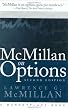 McMillan on Options, Second Edition is considered by many to be THE bible on making money in the options market. And with good reason: this humongous book has everything from the history of the options market to the various options markets as they exist today to the various approaches savvy traders have found to make money buying and selling these contracts.
Some specific topics the reader can dig into include:
Bottom line: this options trading book is simply one of the best in its class - if it is not on your shelf already, get it. If it is, read it again. It houses critical knowledge.
Above all: stay timid!
Timorous
Some specific topics the reader can dig into include:
- in depth coverage of major spreads. Any idiot can tell you a backspread has theoretically unlimited profit potential, but few will cover the impact of changes in volatility or other market conditions. McMillan does exactly that, and understanding his analysis is a huge boost to the option trader anxious to maximize his profit.
- coverage of exotic elements which make options trading so rewarding AND so confusing to the new trader. The Greeks, how they are computed, which are mathematically solid and which are imputed - McMcillan goes into great detail for each and how folks like you and me can profit from them in our own trading.
- Coverage of the predictive power of options markets. In this section, McMillan analyzes various ways the options market can be used to predict the future activity of specific stocks or entire indexes. Contract volume, volatility analysis, put-call ratio, etc.; each are covered in good detail.
- Coverage of trading systems is also offered. McMillan goes through a number of trading systems (not to be confused with a trading plan), showing their expectancy. The reader may or may not want to use any the discussed systems as shown, but the trading systems he discusses offer some good material for possibly creating your own systems, or evaluating some of the many others offered for sale.
Bottom line: this options trading book is simply one of the best in its class - if it is not on your shelf already, get it. If it is, read it again. It houses critical knowledge.
Above all: stay timid!
Timorous
Book Review - Short Term Trading Strategies that Work
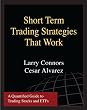
Larry Connors, the author of Short Term Trading Strategies That Work, has published a number of VERY good stock trading books, so when this one came out my expectations were pretty high.
I wasn't disappointed. Covering material that could have been trite (buy
pullbacks, go long when stock is over 200 MA, short when stock is below,
etc.), he raised everything he presented to a new level of instruction by
providing years worth of data proving his points. There are loads of stock
trading books on the market providing buy and sell entry triggers, but few
quantify what they are talking about in a way even approaching what Mr.
Connors has done here.
But this book really challenged me, too. One of my personal mantras over the
years has been "never trade without a stop". In fact, one of the folks who
hammered that into me was Mr. Connors and several other
TradingMarkets.com teachers. So you can imagine my consternation when
Connors informs the reader that, at least with the strategies he is presenting
in this book, stops actually HURT performance! To be honest, I'm still
digesting this claim; I'm not discounting it out of hand, but I've seen too many
scenarios play out where the only thing that saved my trading account from
financial Armageddon was a disciplined use of stops.
Bottom line on this Short Term Trading Strategies That Work: it is one of the
best stock trading books available, is more than worth the price, and will
provide the active trader some great material for their own trading practice.
But it is a bit heretical, and each reader will need to see if every element fits
his/her style of wrestling with the markets. But whether you use every
strategy or not, this book can help you become a stronger trader who relies
on quantifiable data more than their own 'gut' instinct.
Subscribe to:
Posts (Atom)